

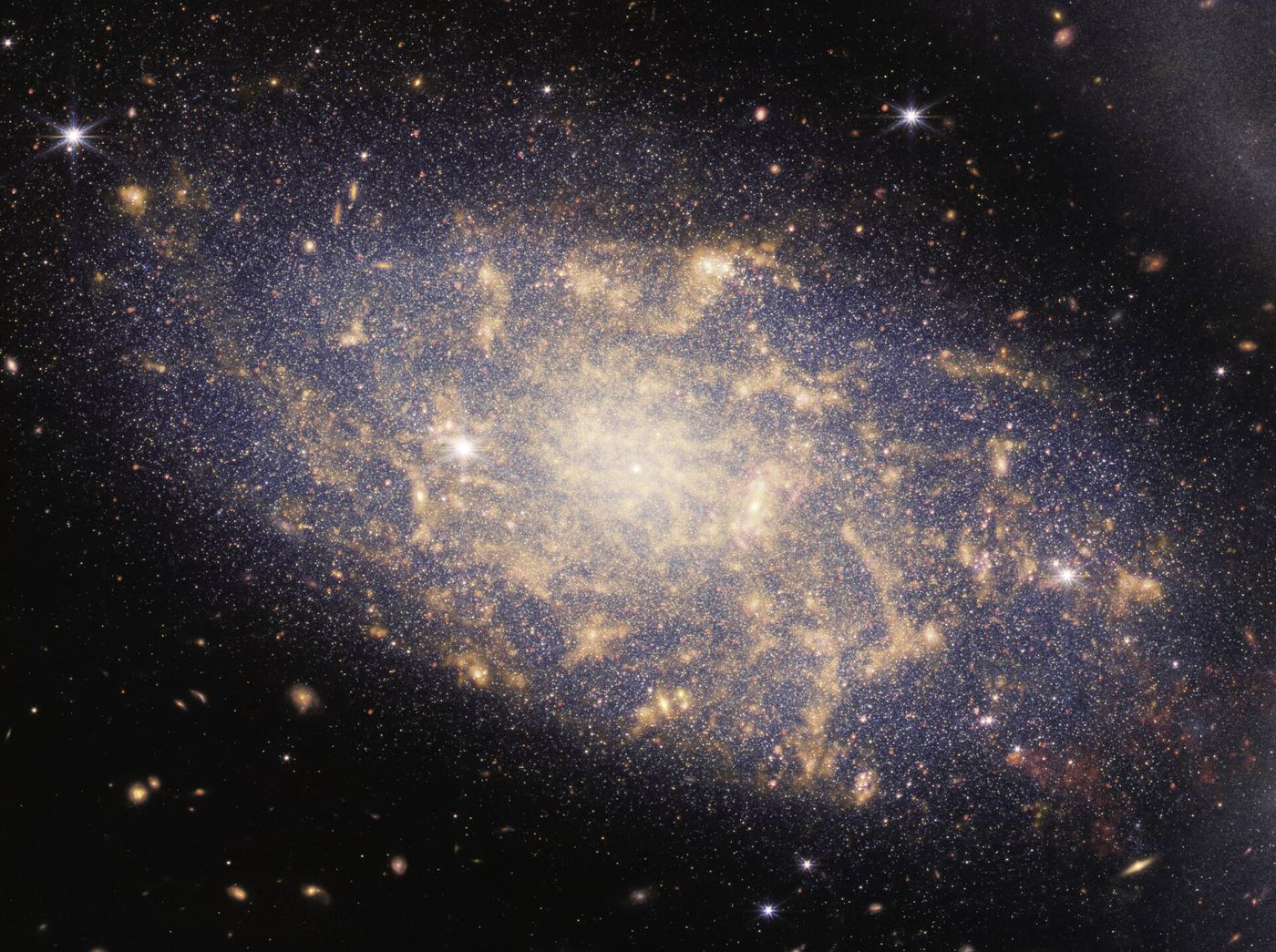
The James Webb Space Telescope has once again pushed the frontier of the observable universe, spotting a galaxy that existed only about 280 million years after the Big Bang. The galaxy, named MoM-z14, is the most distant spectroscopically confirmed object ever found, with a redshift of 14.44, meaning its light has travelled for roughly 13.5 billion years to reach us. Astronomers led by Rohan Naidu at the Massachusetts Institute of Technology announced the discovery after Webb’s NIRSpec instrument spread the galaxy’s faint light into a spectrum, confirming its distance beyond doubt. Surprisingly, MoM-z14 is bright, dense and already chemically rich, far more developed than models predicted for such an early era. The finding, published in the Open Journal of Astrophysics in early 2026, challenges ideas about how quickly the first galaxies could form stars and build up heavy elements. The discovery was made using Webb’s deep survey of the COSMOS field, one of the most intensively studied patches of sky, and the galaxy’s light was first spotted as a faint smudge in infrared images before spectroscopy confirmed its extraordinary distance.
What the Evidence Shows
MoM-z14 replaces the previous record holder, JADES-GS-z14-0, which existed about 300 million years after the Big Bang, and it continues a pattern in which Webb keeps finding unexpectedly mature galaxies in the universe’s infancy. Scientists expected the first galaxies to be small and faint, slowly assembling over hundreds of millions of years, yet Webb has repeatedly found bright, structured systems far earlier than theory allowed. Researchers now debate whether star formation was far more efficient in the early universe, whether the first stars were unusually massive, or whether black holes played a bigger role than assumed. Each new record sharpens the questions rather than settling them, and astronomers expect Webb to break its own record again as its deep surveys continue. For now, MoM-z14 stands as the farthest window yet into the cosmic dawn. The result also matters because the earliest galaxies seeded everything that followed, producing the first stars, the first black holes and the heavy elements that would eventually form planets and people. Reporting and analysis from sources such as NASA track the same developments, and specialists following most distant galaxy MoM-z14 say the direction is now consistent across independent lines of evidence.
The Wider Context
Funding bodies are watching most distant galaxy MoM-z14 closely because the work sits at the junction of basic curiosity and practical return. Grant panels increasingly ask for a path from discovery to application, while researchers push back that the most valuable uses of fundamental science are rarely the ones written into the original proposal. The tension is productive when both sides stay honest about timescales.
What Happens Next
The long view on most distant galaxy MoM-z14 is that fields advance by accumulation rather than by single announcements. This result adds a solid, checkable piece to a structure many teams are building, and its authors have shared their data so the piece can be tested from every side. That is how the picture eventually becomes reliable enough to act on. You can follow related developments in our coverage of science.
It is also worth remembering how quickly the picture in this area has changed before. Positions that looked settled a few years ago have been revised as new data arrived, and the same humility is appropriate now. The strongest coverage of this subject, and the most useful advice, tends to come from sources that update their views openly when the facts move, rather than defending an earlier position long after it has stopped fitting the evidence available.
